Professor Angela A. Allen-Bell and her advocacy in favor of the Angola 3.
August 18, 2015 / Author: William Fox C
Short profile about Angela A. Allen-Bell. I did this interview on my first term at the Graduate Diploma in Journalism at Concordia University. I am sure Journalism can help bring about change for justice. Yes, more like an independent journalism piece. At sometimes we must stand for something.
Angela A. Allen-Bell advocates against prolonged solitary confinement. According to her, this practice warrants deep reform in the United States.
Bell explains solitary confinement is “a practice of housing inmates under isolated conditions. These inmates live alone in cells where they are held for 23 hours a day.” There is little or no social interaction. Natural lighting is often limited at well. Inmates in solitary confinement do not get to partake in classes or activities in the facility.
“Most inmates held in solitary confinement have no contact with the outside world other than the U.S. mail,” she said. “Depending on the state, inmates have limited access to visitors, as well as to the prison library.” Cells often have only a bed, a sink, and a desk. Even space is reduced, often to dimensions of 6×9. “A number of the isolated prisoners live with extensive surveillance and security controls,” she explains.
Inmates can be put into solitary confinement for disciplinary reasons (violation of prison rules by inmates) or administrative ones. “The latter is the more troubling of the two practices because of the many documented instances where this discretion is abused and the inmate, who never committed an infraction behind prison walls, is left in solitary confinement indefinitely,” said Bell.
Bell has been advocating for many years in favor of the Angola 3.The group started the first chapter in prisons of the Black Panther Party, a service, and empowerment organization. The name refers to its three members, Albert Woodfox, Robert King and the late Herman Wallace, and to the nickname that is given to the Louisiana State Penitentiary, “Angola.”
Two members of the Angola 3 were in Angola serving time on different charges when a guard was murdered in April 1972. They were immediately removed from their dorms and placed in solitary confinement. The third Angola 3 member arrived at Angola after this murder. Yet he too was placed in solitary confinement. Prison official told him he was being placed in solitary confinement because he was under investigation. “The Angola 3 took a stand against prison conditions at a time of strong corruption and violence at Angola,” she said. “They wanted a safe prison and one that was free of sexual exploitation and constitutional and human rights violations.”
They paid a big price for their sacrificial work and their activism. “What they got in exchange for this is near death sentences, false imprisonment, persecution, torture and legal lynching’s,” she added.
Albert Woodfox is still in prison and in solitary confinement. His present conditions are more extreme than the conditions previously described. His shower is currently inside his cell, along with his bed, sink, and desk so his exits are fewer. Robert King was released in 2001. He spent all of his time at Angola in solitary confinement (“under investigation” for the murder of the guard that happened before he arrived). Herman Wallace died shortly after being released in 2013. He was 71- years-old. He spent 41 years in solitary confinement. He was diagnosed with advanced cancer a few months before his release. He lived to experience three days of freedom. Before dying, he wrote these words to Bell: “I am a soldier, my sister—a servant of the people—and if I am taken down anytime soon, my only wish is that the struggle does not end with me.”
Religious beliefs are crucial in her determination to advocate against solitary confinement. “The Bible calls us to defend the rights of the poor and the needy (Proverbs 31:8-9) and to give justice and to maintain the rights of the afflicted (Psalm 82:3, Jeremiah 5:1 & Micah 6:8),” she said.
Besides, Bell’s research has also shown that changes are needed in the way solitary confinement is being administered. “There is no disputing the fact that this practice is being abused and overused in the United States. Moreover, medical research, legal precedent and human rights principles suggest that changes are needed,” she stated.
Bell also said that the love for her country influenced her fight against solitary confinement, “I strongly feel what we are doing in the United States where solitary confinement is concerned (especially in Louisiana) is costing us credibility with members of the global community.”
One of the most relevant deficiencies, according to Bell, is the way solitary confinement is being treated and administered, and in particular, how individuals are selected for it. She considers this process is tragically flawed, “there is too much discretion and discretion is often abused.” Worse, the most vulnerable inmates are often trapped in this system.
Another major deficiency she has pointed out is the due process hearings inmates must go through in order to be released from solitary confinement. “A simulated process akin to a hearing, where formalities can be documented, but where no meaningful probing occurs, is unjust and unconstitutional,” she said. “It amounts to nothing more than procedural automation in a legal assembly line where unfavorable reviews are mass-produced.”
Bell first learned about solitary confinement in college. Many of her mentors were activists, leaders and/or social change agents. Her social, legal and religious convictions and some personal experiences were fundamental in shaping her character. “I am the product of Catholic schools that impressed upon me the obligation to use my gifts in service to mankind and in obedience to God,” she explained.
Also, her family was an important influence in voicing her opinions. “There are no pacifists in my family. I descend from a bloodline of people who know how to take a stand and who have the courage to do so when the situation warrants such,” she said.
Bell supports other causes that advocate for the rights of others and against injustices and abuses. She is active in religious causes, social justice causes, causes involving at-risk children, the indigent, and reentry-related causes.
She mentors high school students, as well as college and law students. She rescues pets, is active at church and makes motivational speaking and professional presentations regularly. The source of her energy comes from “the feeling that she is doing what it is that she was uniquely and divinely purposed to do,” she said.
She loves poetry, which she defines as “a thoughtful, well-constructed and deliberate written release of emotions.” But this passion is not the only field where she believes in the power of words. “Words can liberate, destroy, empower and/or enlighten,” she said. “I believe in the power of words and endorse using words to mobilize and move people to action.” For many years, she has been a lawyer, a professor of legal writing and analysis and researcher and author.
Other passions she has, are reading books that talk “about people who defy obstacles and stories about sacrifices, changes, and advancements that were made to better conditions for others.” She remarked that “We must be on an evolving journey to be our best selves. ”In order to make a better world, we must never become slaves to tradition.”
In fact, she thinks that people can help with this cause: “Albert Woodfox is now 68-years-old. A court ordered his release in June 2015. He can’t leave due to an appeal filed by Louisiana Attorney General. His appeal will be heard on September 2, 2015. No injustice ever ended because of apathy, indifference, silence or inaction. Immediately, he needs our prayers and support. Collectively, he needs us to do for him what he did for others once he arrived at Angola: stand up, speak out, show up, disrupt what must be disrupted and fix what is in need of repair. This injustice and human wrong must stop!
The cause Bell was leading to free Albert Woodfox, finally got the most desired outcome. “I am happy to report that Angola 3 member Albert Woodfox was released on 2/19/16,” wrote Bell to me in March 2016.
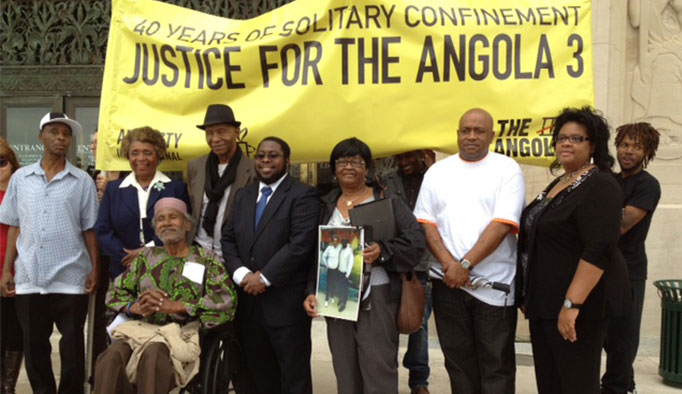
Professor Bell at the right. The delegation that accompanied Amnesty International at the Louisiana State Capitol on April 17th, 2012. Photo credit:
http://angola3news.blogspot.ca